
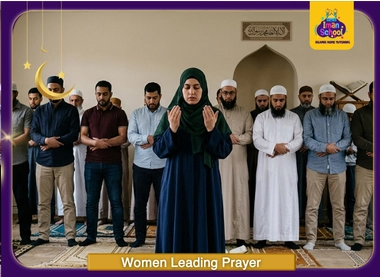
 -by
-by Understanding the ruling on Women Leading Prayer helps Muslims navigate traditional jurisprudence (Fiqh) accurately. Discussions surrounding Women Leading Prayer often raise questions regarding leadership in congregational Salah. At Iman School, our certified scholars offer structured online jurisprudence courses, guiding Western students through classical Islamic knowledge with spiritual clarity and academic depth.
Can a Woman Lead Prayer?
The short answer regarding Women Leading Prayer depends entirely on who makes up the congregation. The vast consensus across classical Islamic jurisprudence distinguishes clearly between leading an all-female congregation and leading a mixed or male-only congregation.
Under mainstream Islamic law, a woman is fully permitted to lead other women in congregational prayers (Jama’ah).
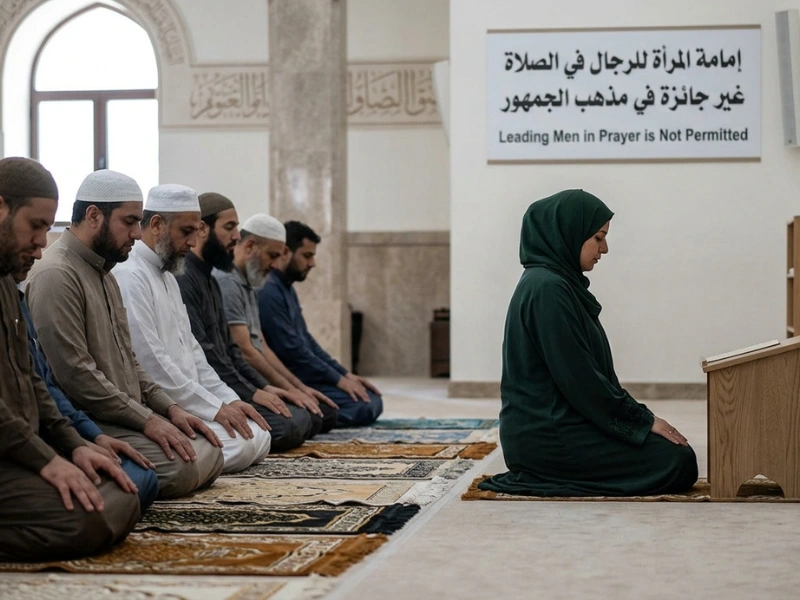
However, when asking can women lead prayer for men, the overwhelming majority of classical jurists and contemporary rulings—including official decrees from Egypt’s Dar Al-Ifta—state that a woman does not lead men or mixed groups in obligatory congregational prayers.
Join Now: Fiqh program
Can a Woman Lead Other Women in Prayer?
Ruling
Leading an all-female congregation is highly recommended (Mustahabb) or permissible according to the majority of scholars. Narrations from prominent female figures in early Islam, including Aisha bint Abi Bakr and Umm Salamah (may Allah be pleased with them), confirm that they led women in congregational prayers.
Where the Female Imam Stands
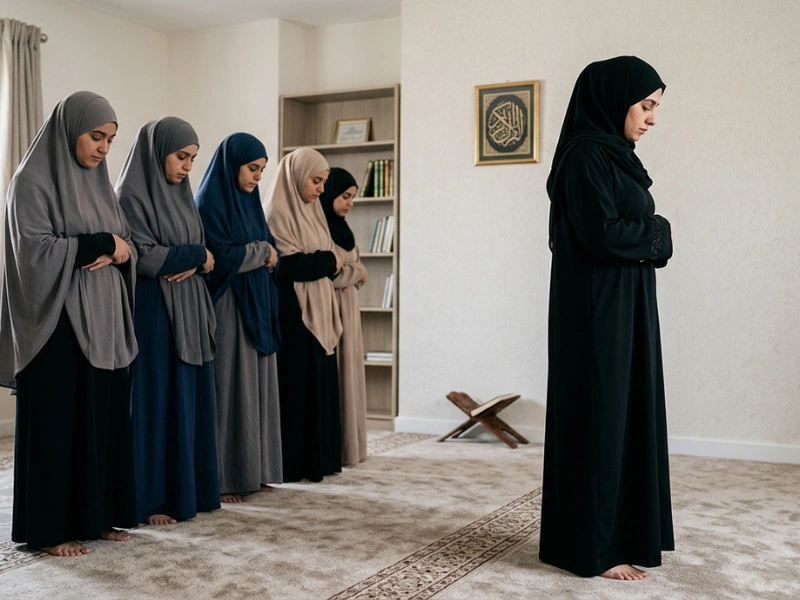
Unlike a male imam who stands forward ahead of the congregation, a female imam in Islam leading other women stands directly in the middle of the first row. This positioning maintains modesty and unity within the congregation.
Obligatory Prayers
Women are fully permitted to gather and perform all five daily obligatory prayers (Fard) together. The female leader recites aloud in prayers where recitation is public (Fajr, Maghrib, and Isha) and silently during secret recitation prayers (Dhuhr and Asr).
Voluntary Prayers
Leading other women in voluntary (Nafl) and night prayers is equally praised. Exploring the Islamic ruling on female imam guidance shows that sisters can easily gather at home to perform voluntary night prayers together under female leadership.
Understanding women leading prayer in Islam for all-female groups encourages communal worship among sisters.
Learn More: Botox and Fillers in Islam
Can a Woman Lead Men in Prayer?
When addressing whether a woman leading Salah can lead male congregants, classical Islamic jurisprudence presents a clear consensus. Major jurists from all primary legal traditions prohibit a woman from leading men in mandatory congregational prayers.
Official decrees from bodies like Dar Al-Ifta highlight that Islamic leadership roles in mixed public worship assign the role of leading mixed congregations exclusively to men.
The evidence cited by jurists includes unbroken historical practice (Amal) from the time of Prophet Muhammad (peace be upon him), the Companions, and centuries of scholarly consensus (Ijma’). Therefore, evaluating if can a woman be an imam for men yields a negative position across classical Sunni legal frameworks.
Learn More: Can You Read Quran Without Ghusl
Where Does a Female Imam Stand?
Understanding proper alignment during congregational prayer is essential for correct performance:
Leading Women
When a sister leads a group consisting entirely of women, she does not step forward into a separate mihrab space. Instead, she stands in the center of the front row, aligned side-by-side with the other female congregants.
Read Also: Does a Woman Have to Wear Hijab When Reading Quran
Praying Behind a Male Imam
In a mixed setting or public mosque, women form rows behind the men. This arrangement preserves focus, decorum, and spiritual reflection for all worshipers.
Praying With Her Husband
When a woman prays at home with her husband, he stands forward as the imam, and she stands behind him in a separate row, even if she is the only follower in the congregation.
Learning these details ensures women praying in congregation maintain precise traditional etiquette.
Learn More: Body Piercings Islamic Ruling
Can Women Lead Mixed Congregational Prayers?
The mainstream position across Sunni scholarship strictly prohibits a female imam prayer leading a mixed-gender congregation. While contemporary debates occasionally surface in Western media, classical scholars agree that leading mixed public prayers is reserved for men.
The prohibition of Women Leading Prayer in mixed settings is not a reflection of spiritual worth or intellectual capacity. In Islam, men and women possess equal spiritual status before Allah. Leadership roles in public worship carry specific structural responsibilities, and maintaining traditional prayer arrangements honors authentic prophetic guidelines.
What Do the Four Sunni Schools Say?
When evaluating can a woman lead other women in prayer, examining the four classical Sunni legal schools (Madhhabs) provides clear consensus on female congregations alongside subtle operational details:
- Hanafi School: Considers a woman leading other women to be permissible, though slightly disliked (Makruh Tanzih) to organize needlessly. If performed, the female leader stands in the middle of the row.
- Shafi’i School: Strongly recommends female congregations for women, viewing it as a praised Sunnah. The female imam stands in the middle of the front row.
- Hanbali School: Fully permits women to lead other women in both obligatory and voluntary prayers, with the leader standing centered in the front line.
- Maliki School: The predominant view within the Maliki tradition considers leading prayer to require a male leader for both male and female followers, though individual private prayers remain fully valid.
Regarding the question can a woman lead men in prayer, all four legal schools unanimously agree that a woman cannot lead men in obligatory or voluntary congregational Salah.
Read Also: Laser Hair Removal Islamic Ruling
FAQ About Women Leading Prayer
Can a woman lead other women in Salah?
Yes, a woman can lead other women in both obligatory and voluntary prayers, standing in the middle of the front row.
Where does a female imam stand?
A female imam leading other women stands directly in the center of the first row alongside the other female worshipers.
Can a woman lead men in prayer?
No, according to the overwhelming consensus of classical Sunni jurists, a woman cannot lead men in congregational prayer.
Can a woman lead her husband in prayer?
No, a wife cannot lead her husband in Salah. The husband stands forward as the imam, and the wife prays in a row behind him.
Can a woman lead a mixed congregation?
No, classical Islamic jurisprudence strictly prohibits women from leading mixed-gender congregations in obligatory or voluntary prayers.
Can women pray together in congregation?
Yes, women praying in congregation is a praised practice that builds sisterhood, spiritual growth, and correct recitation habits.
Can a woman lead Taraweeh for other women?
Yes, a woman may lead other women in voluntary night prayers (Taraweeh) during Ramadan, reciting aloud while standing in the center of the front row.
Can a woman teach other women how to pray?
Absoloutely. Teaching prayer, Tajweed, and Fiqh to other women is a highly rewarded form of Islamic education.
Discover More: Why can’t Muslim women pray on their period
Master Fiqh and Islamic Jurisprudence With Iman School
Gaining a deep, authentic understanding of Islamic jurisprudence empowers Muslim women to practice their faith with confidence and clarity. At Iman School, Best online academy we offer structured online courses in Fiqh, Tajweed, and Quranic studies tailored specifically for sisters and families living in Western societies.
Our comprehensive curriculum explores classical rulings on purification, Salah, family law, and daily worship. Guided by certified female and male scholars, students learn how traditional legal principles apply to contemporary life in a supportive, interactive environment.