 -by
-by Exploring the true Meaning of Surah Ikhlas unlocks the heart of Islamic theology in just four short, powerful verses. Studying the Meaning of Surah Ikhlas strengthens a believer’s faith and clarifies the absolute oneness of God. At Iman School, we help adults and children build a solid spiritual foundation through engaging, personalized online classes.
What Is Surah Ikhlas?
Surah Al-Ikhlas is the 112th chapter of the Holy Quran, consisting of four short verses. According to the majority of Quranic scholars, it was revealed in Makkah during the early period of Islam. The title Al-Ikhlas translates to “Sincerity” or “Purity of Faith.”
It earned this noble name because the entire chapter is dedicated exclusively to describing the purity, oneness, and majesty of Allah SWT, free from any human attributes or false associations.
The main subject of this surah is Tawheed, the absolute monotheism that defines Islamic belief. The Prophet Muhammad ﷺ described this chapter as equivalent to one-third of the entire Quran because it encapsulates the central core of Islamic creed.
Grasping the true Meaning of Surah Ikhlas is essential for every Muslim seeking to purify their intention, worship Allah alone, and understand the core tenets of faith. Exploring this chapter through a structured Islamic Studies Course helps non-Arabic speakers connect deeply with divine revelation.
See More: Common Quran Learning Mistakes to Avoid
Surah Ikhlas in Arabic, English, and Transliteration
To help you study and reflect on each verse, here is the full chapter presented with its original Arabic script, precise surah ikhlas translation, clear surah ikhlas transliteration, and an easy-to-understand breakdown.
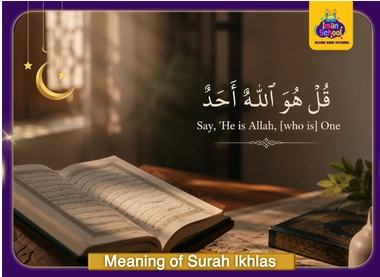
Verse 1: قُلْ هُوَ اللَّهُ أَحَدٌ
English Translation: “Say, ‘He is Allah, [who is] One.'”
Transliteration: Qul huwallahu ahad.
Meaning and Explanation: This opening verse begins with a direct divine command (Qul – “Say”), addressing the Prophet Muhammad ﷺ and all believers to announce God’s absolute uniqueness. The word Ahad goes far beyond the simple number one. While Wahid refers to single in count, Ahad signifies a unique, incomparable oneness that cannot be divided, duplicated, or matched. Internalizing the Meaning of Surah Ikhlas starts right here: recognizing that Allah is singular in His essence, His rights, and His divine attributes.
Verse 2: اللَّهُ الصَّمَدُ
English Translation: “Allah, the Eternal Refuge.”
Transliteration: Allahus-samad.
Meaning and Explanation: Understanding this verse relies heavily on the profound word As-Samad. Classical Arabic linguists explain that As-Samad describes the Self-Sufficient Master upon whom all creation depends, while He depends on no one. Everything in existence needs Allah for life, sustenance, and guidance, yet He is completely free of all needs. Reflecting on this name deepens your appreciation of the Meaning of Surah Ikhlas, inspiring you to turn exclusively to Allah in times of hardship and daily supplication.
Verse 3: لَمْ يَلِدْ وَلَمْ يُولَدْ
English Translation: “He neither begets nor is born.”
Transliteration: Lam yalid wa lam yoolad.
Meaning and Explanation: This verse explicitly denies that Allah has children, parents, or any familial lineage. It protects the Islamic belief system from the common errors of pagan mythology and humanized theology. Creation requires parents to come into existence and children to carry on a lineage; Allah, being eternal (As-Samad), transcends time, birth, and mortality. Reading this surah ikhlas in english reinforces that the Almighty is completely exalted above human physical limitations.
Verse 4: وَلَمْ يَكُن لَّهُ كُفُوًا أَحَدٌ
English Translation: “Nor is there to Him any equivalent.”
Transliteration: Wa lam yakul-lahu kufuwan ahad.
Meaning and Explanation: The final verse concludes the surah by stating that nothing in the universe is equal, similar, or comparable to Allah. The word Kufuwan means peer, equal, or rival. This verse firmly establishes that no created being shares God’s divine power, knowledge, or right to worship. Delving into this comprehensive surah ikhlas explanation helps believers purify their minds from any subtle forms of idolatry or anthropomorphism.
Continue Reading: Teaching Children to Speak the Truth
Word-by-Word Meaning of Surah Al-Ikhlas
Looking at the key words in each verse makes the meaning of Surah Al-Ikhlas easier for beginners and non-Arabic speakers to understand.
Verse 1: قُلْ هُوَ اللَّهُ أَحَدٌ
- قُلْ (Qul): Say
- هُوَ (Huwa): He
- اللَّهُ (Allah): Allah
- أَحَدٌ (Ahad): One, Unique
The verse commands the Prophet Muhammad ﷺ to proclaim the absolute Oneness and uniqueness of Allah.
Verse 2: اللَّهُ الصَّمَدُ
- اللَّهُ (Allah): Allah
- الصَّمَدُ (As-Samad): The One upon whom creation depends; the Self-Sufficient Master
This verse emphasizes that Allah has no need for creation, while every created being depends upon Him.
Verse 3: لَمْ يَلِدْ وَلَمْ يُولَدْ
- لَمْ (Lam): Not / did not
- يَلِدْ (Yalid): Beget
- وَلَمْ (Wa lam): And did not
- يُولَدْ (Yulad): Be born
The verse rejects the idea that Allah has children, parents, or a created origin.
Verse 4: وَلَمْ يَكُن لَّهُ كُفُوًا أَحَدٌ
- وَلَمْ (Wa lam): And there is not
- يَكُن (Yakun): Is / exists
- لَهُ (Lahu): For Him
- كُفُوًا (Kufuwan): An equal or comparable
- أَحَدٌ (Ahad): Anyone / anything
The final verse confirms that nothing is equal or comparable to Allah in His essence, attributes, or divinity.
What Does Surah Al-Ikhlas Mean in Simple English?
Surah Al-Ikhlas explains who Allah is and establishes the foundation of Islamic belief in His absolute Oneness. In simple English, the four verses can be understood as follows:
- Allah is One and Unique: There is no other god who shares His divinity, authority, or right to be worshipped.
- Allah is As-Samad: He is completely independent, while all creation depends on Him for existence, provision, and guidance.
- Allah has no parent or child: He was not born, and He does not have offspring. His existence is unlike the existence of created beings.
- Nothing is comparable to Allah: No person, creature, power, or being is equal or similar to Him.
The meaning of Surah Al-Ikhlas therefore goes beyond simply stating that Allah is one. It describes His unique nature, absolute independence, and complete freedom from any weakness or similarity to creation. This is why the surah holds such an important place in understanding Tawheed, the Islamic belief in the Oneness of Allah.
What Is the Main Message of Surah Ikhlas?
While each verse carries profound individual weight, the main message of the entire chapter emerges when you examine the four verses as an interconnected whole. The surah systematically builds a complete blueprint of Islamic monotheism:
- Verse 1 establishes Allah’s unique Oneness (Ahad).
- Verse 2 establishes His absolute Independence (As-Samad).
- Verse 3 denies physical lineage or origin (Lam yalid wa lam yoolad).
- Verse 4 rejects any partners, rivals, or comparisons (Kufuwan ahad).
Together, these four short lines form the ultimate summary of Tawheed. Understanding the Meaning of Surah Ikhlas is not just an intellectual exercise; it shapes how a believer prays, relies on God, and perceives the entire universe. Adults looking to deepen their grasp of these theological foundations can enroll in interactive Islamic Classes for Adults to study classical commentaries with qualified scholars.
Why Was Surah Al-Ikhlas Revealed?
Surah Al-Ikhlas addresses one of the most fundamental questions of Islamic belief: Who is Allah?
Reports concerning the reason for its revelation include questions directed to the Prophet Muhammad ﷺ about the nature, description, or lineage of his Lord. The reports differ in their wording and details, so they should not be presented as though there is only one unanimously agreed-upon account.
The surah responds by giving a concise and powerful description of Allah. He is One and Unique, As-Samad, neither born nor a parent, and completely incomparable to creation.
Rather than providing a human description of Allah, Surah Al-Ikhlas establishes what Muslims affirm about Him and what they must reject: Allah has no partner, no offspring, no origin, and no equal.
This makes the surah a concise foundation for understanding Tawheed and the Islamic concept of Allah’s absolute perfection.
View Details: Tashahhud in Prayer
Why Is Surah Al-Ikhlas Equal to One-Third of the Quran?
The Prophet Muhammad ﷺ described Surah Al-Ikhlas as equivalent to one-third of the Quran in reward and significance. This is established in an authentic hadith recorded in Sahih al-Bukhari.
Scholars have explained this virtue in different ways, including the central place of Tawheed and the knowledge of Allah within the Quran. Surah Al-Ikhlas concentrates on this major subject in only four verses, affirming Allah’s Oneness, independence, and uniqueness.
However, describing the surah as equivalent to one-third of the Quran does not mean that a Muslim can replace the entire Quran with repeated recitation of Surah Al-Ikhlas. The Quran contains many other essential subjects, including worship, guidance, laws, stories, reminders, and moral teachings.
The special virtue of Surah Al-Ikhlas highlights the extraordinary importance of knowing Allah and maintaining pure Tawheed.
What Are the Virtues of Surah Al-Ikhlas?
Surah Al-Ikhlas has several established virtues in authentic Islamic sources. Understanding these virtues helps explain why Muslims frequently recite this short chapter in their daily worship and remembrance.
It Is Equal to One-Third of the Quran
The Prophet Muhammad ﷺ said that Surah Al-Ikhlas is equivalent to one-third of the Quran. This highlights the immense importance of the Tawheed and knowledge of Allah expressed throughout the surah.
Loving Surah Al-Ikhlas Is a Sign of Faith
A companion used to recite Surah Al-Ikhlas because he loved the attributes of Allah mentioned in it. When the Prophet ﷺ was informed about this, he said that Allah loved him because of his love for the surah.
Keep Reading: Rewarding Muslim Children for Quran and Salah
It Can Be Recited Regularly
Surah Al-Ikhlas is among the short surahs that Muslims commonly include in their daily prayers and remembrance. Its concise wording makes it easy to memorize while carrying a profound message about the nature and Oneness of Allah.
These virtues should encourage Muslims not only to recite Surah Al-Ikhlas but also to reflect on its meaning and apply its message of sincere worship and Tawheed in their lives.
Key Lessons from Surah Ikhlas
Reflecting deeply on this chapter yields several life-changing lessons from surah ikhlas:
- Allah is One and Unique: He has no partners, associates, or rivals in His dominion.
- Allah Alone Deserves Worship: Because He is the sole Creator, no prayer, vow, or worship should be offered to anyone else.
- Allah is Independent and Free of Need: He sustains the entire universe without growing tired or requiring assistance.
- Allah Has No Family: He is exalted above human physical concepts such as fatherhood, childhood, or ancestry.
- Nothing Is Comparable to Allah: His names, attributes, and perfection are infinitely beyond human imagination.
- Tawheed Is the Heart of Islam: True spiritual success begins with purifying your creed from all forms of association or doubt.
Ready to Start Your Learning Journey?
Join thousands of students worldwide and experience authentic Islamic education with certified scholars. Secure your spot today and transform your understanding.
* Limited seats available for new enrollments
What Does Surah Ikhlas Teach Us About Tawheed?
The chapter serves as the definitive textual foundation for the concept of Tawheed. Islamic scholars divide Tawheed into three primary categories:
- Tawheed ar-Rububiyyah (Oneness of Lordship): Affirmed in Verse 2 (As-Samad), showing Allah as the ultimate Creator and Controller of all things.
- Tawheed al-Uloohiyyah (Oneness of Worship): Expressed in Verse 1 (Ahad), demonstrating that only the One unique God deserves our worship.
- Tawheed al-Asma was-Sifat (Oneness of Names & Attributes): Highlighted in Verses 3 and 4 (Lam yalid… Kufuwan ahad), proving that His attributes are completely unique and free from defects.
Understanding how this chapter encompasses every branch of Islamic creed makes it an ideal stepping stone for those pursuing an Islamic Creed Course. By analyzing the surah al ikhlas meaning, students build an unshakeable theological framework that protects them against ideological doubts.

How to Explain Surah Al-Ikhlas to Children
Surah Al-Ikhlas is one of the easiest chapters to introduce to children because it contains only four short verses and teaches a central principle of Islam: Allah is One.
Parents and teachers can explain its main ideas using simple concepts:
- Allah is One: There is no one like Allah and no one who shares His divinity.
- Allah does not need anyone: Everything we have comes from Allah, while Allah does not depend on His creation.
- Allah was not born: Allah does not have parents or a family like human beings.
- Nothing is like Allah: We should never imagine Allah as being similar to anything we see in creation.
Children can then connect these meanings to their daily lives by learning that they should worship Allah alone, ask Him for help, and appreciate His blessings.
Teaching the meaning alongside memorization allows children to understand what they recite rather than simply repeating Arabic words. Personalized Quran lessons can make this process easier for young learners who are still developing their Arabic reading and Quran recitation skills.
How to Memorize and Recite Surah Ikhlas Correctly
Because Surah Al-Ikhlas is short, it is usually one of the very first chapters children and adult converts memorize. However, proper pronunciation and Tajweed are essential to ensure the words are read accurately:
- Master the Heavy and Light Letters: Pay attention to the letter Qaf in Qul, it should be pronounced heavily from the back of the throat, distinct from a soft English K.
- Observe the Qalqalah (Echoing Sound): The letter Dal at the end of Ahad, Samad, Yalid, Yoolad, and Ahad requires a crisp bouncing sound when pausing.
- Practice Short and Long Vowels: Do not stretch short vowels unnecessarily, and ensure the long vowel in Yoolad receives its proper two-count duration.
Working with a skilled tutor through live Online Quran Classes is the fastest way to polish your pronunciation, correct subtle reading mistakes, and experience the physical surah ikhlas benefits during prayer.
We offer customized courses tailored to every skill level, including Tajweed Course Online, Quranic memorization, Arabic language studies, and foundational Islamic theology. We provide flexible scheduling, gender-specific tutors, and structured learning paths designed to fit your family’s routine.
Common Questions About Surah Ikhlas
What does Surah Ikhlas mean?
The Meaning of Surah Ikhlas centers on the absolute oneness, self-sufficiency, and perfection of Allah, affirming that He has no partners, children, or equals.
Why is Surah Ikhlas important?
It is considered equivalent to one-third of the Quran because it contains the pure, complete essence of Islamic monotheism (Tawheed).
What does Allahu Samad mean?
It means “Allah, the Eternal Refuge” or “the Self-Sufficient Master.” It signifies that all creation depends on Allah, while He depends on no one.
What does Ahad mean in Surah Ikhlas?
Ahad means One and Unique. It describes an absolute, indivisible oneness that cannot be replicated or compared to anything in creation.
What does Surah Ikhlas teach about Tawheed?
It teaches all three aspects of Tawheed: that Allah is the sole Lord, the only one worthy of worship, and completely unique in His divine names and attributes.
What are the benefits of reading Surah Ikhlas?
Reciting it sincerely brings Allah’s love, earns immense rewards, protects the believer from harm, and serves as a means of gaining Paradise.
Why was Surah Ikhlas revealed?
It was revealed in response to polytheists and critics who asked the Prophet Muhammad ﷺ to describe the lineage and nature of his God.
Is Surah Al-Ikhlas about Tawheed?
Yes. Surah Al-Ikhlas strongly affirms Tawheed by declaring Allah’s absolute Oneness, independence, and uniqueness. It rejects the belief that Allah has a partner, child, parent, or equal.
Why is Surah Al-Ikhlas called the Surah of Sincerity?
The name Al-Ikhlas is commonly translated as “Sincerity” or “Purity.” The surah focuses exclusively on the Oneness and perfection of Allah, making pure belief in Him its central theme.
What does As-Samad mean in Surah Al-Ikhlas?
As-Samad describes Allah as the One upon whom creation depends while He is completely independent of His creation. The word carries a deep meaning that includes Allah’s perfection, independence, and authority.
Can children learn the meaning of Surah Al-Ikhlas?
Yes. Because the surah contains only four verses, children can learn both its recitation and basic meaning at an early age. Explaining each verse with simple examples can help them connect memorization with Islamic belief.
What is the main lesson of Surah Al-Ikhlas?
The central lesson is that Allah is absolutely One, perfect, independent, and incomparable. Muslims are therefore called to worship Him alone and avoid associating any partner with Him.
Best Online Academy to Learn Quran and Islamic Studies
Unpacking the Meaning of Surah Ikhlas provides a powerful reminder of why we worship Allah alone and how divine revelation enriches our daily lives. Whether you are beginning your journey in Quranic study or looking to strengthen your family’s understanding of Islamic theology, having qualified teachers makes all the difference.
At Iman School, we take pride in being recognized as the Best Online School to Learn Quran Online for Muslim families across Western nations. Our platform brings qualified, English-fluent scholars directly into your home through flexible, interactive one-on-one virtual sessions.