 -by
-by The question of “What is the Fake nails Islamic ruling?” is one of the most frequently asked questions by Muslim women around the world. As fake nails, including acrylic, gel, and press-on nails, have become a popular form of beautification, many Muslim women seek to understand their permissibility within the boundaries of Islamic law. This article will provide a clear and detailed guide to the Fake nails Islamic ruling, addressing the primary concerns related to Wudu (ablution) and prayer, as well as the nuances of different types of nails.
What is the general Islamic ruling on wearing fake nails?
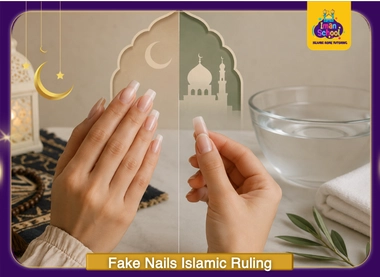
The general consensus among scholars from all major schools of Islamic jurisprudence is that wearing fake nails is not permissible if they prevent water from reaching the natural nail during Wudu. Since Wudu is a prerequisite for prayer (Salah), any act that invalidates Wudu would, by extension, prevent one from fulfilling the obligation of prayer. Therefore, for a Muslim who performs the five daily prayers, the general Fake nails Islamic ruling is that they are not allowed if they are a barrier to water.
Why is Wudu (ablution) the main concern when it comes to fake nails?
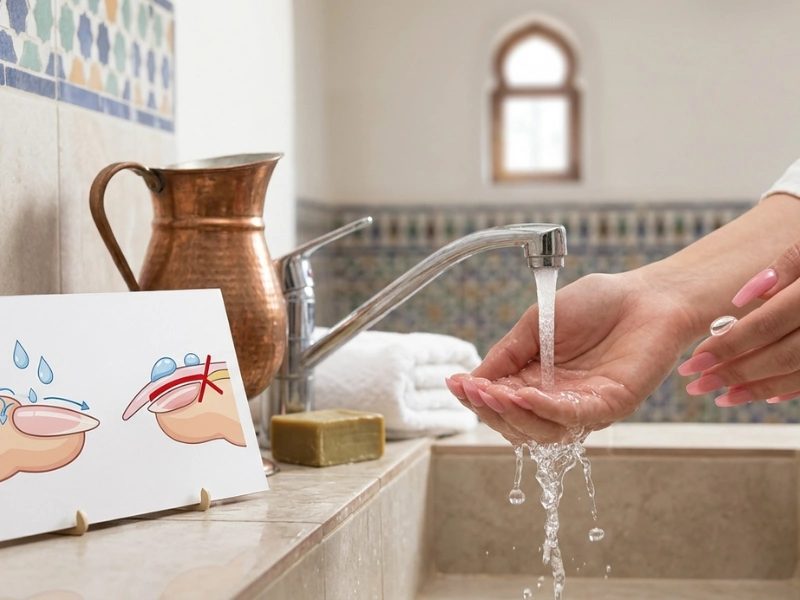
Wudu is a ritual purification that involves washing specific parts of the body, including the hands up to the elbows. For Wudu to be valid, the water must physically reach the skin and nails.
A primary condition for a valid Wudu is that there should be no barrier or substance on the parts of the body being washed that would prevent water from touching the skin. Since fake nails are applied with a strong adhesive or a semi-permanent layer, they form an impervious barrier that blocks water from reaching the natural nail. This is the central issue of fake nails and Wudu, and why it is a major concern.
Read Also: Laser Hair Removal Islamic Ruling
What is the difference between different types of fake nails in Islam?
The Fake nails Islamic ruling varies based on the type of nail and how it is applied.
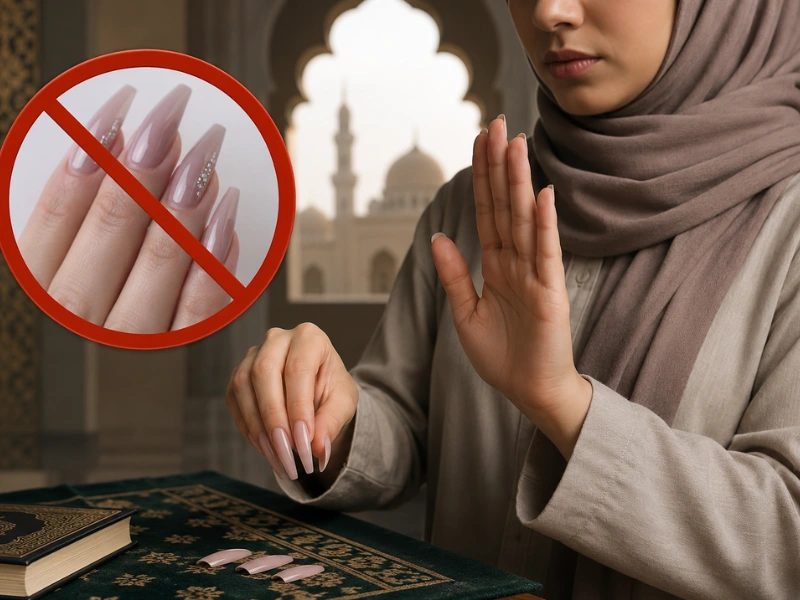
- Acrylic and Gel Nails: These are considered permanent or semi-permanent and are typically not designed to be removed daily. They form a solid, waterproof layer over the natural nail. For this reason, the Islamic ruling on acrylic nails and the question, “is it haram to wear gel nails?” are answered with the conclusion that they are generally impermissible for a woman who prays. This also applies to the Islamic ruling on permanent nails.
- Press-on Nails: These are different because they are often designed for easy removal. The question, “are press-on nails haram?” depends on whether they can be easily removed for Wudu. If a woman can effortlessly remove her press-on nails, perform Wudu, and then reapply them, the issue of the barrier is resolved. This is the core of the discussion on Wudu with press-on nails.
Are fake nails considered a form of adornment that is permissible in Islam?
Yes, from a purely aesthetic perspective, fake nails are a form of adornment (Zinah), which is generally permissible in Islam. Islamic teachings encourage cleanliness and moderate beautification within the boundaries of the Shari’ah. The primary issue with fake nails is not the adornment itself, but the conflict that arises between the adornment and a fundamental act of worship.
This highlights the principles of Muslim women’s beauty rules and the Islamic perspective on adornment.
Do fake nails invalidate my Wudu?
Yes. The moment you apply fake nails, they create an impenetrable barrier on your nails. According to the Fake Nails Islamic Ruling, if you perform Wudu without removing them, your Wudu is invalid because the water did not reach the entirety of your hands. This is the straightforward answer to does nail glue invalidate Wudu and fake nails in Islam for Wudu. The glue itself acts as a barrier, and therefore, the Wudu is not complete.
Can I pray with fake nails on if my Wudu is not valid?
No. Prayer (Salah) is not valid without a valid Wudu. Since fake nails prevent water from reaching your natural nails, your Wudu is incomplete. Based on the Fake Nails Islamic Ruling, it is not permissible to perform an invalid prayer. The answer to “can I pray with fake nails on?” is a definitive no, as the prayer would not be accepted.
Learn More: Body Piercings Islamic Ruling
What is the ruling on press-on nails that can be removed for Wudu?
The Fake Nails Islamic Ruling regarding press-on nails that can be removed for Wudu is one of the key exceptions. If a woman can remove the nails with ease, perform her Wudu, and then reattach them, this is considered permissible.
This is because the barrier is temporary and is removed for the sake of worship. Under the Fake Nails Islamic Ruling, this is the condition in which “are press-on nails removable for Wudu?” becomes the determining factor of permissibility.
Is it permissible to wear fake nails during menstruation (period)?
Yes. During menstruation, a woman is not required to perform Wudu or prayer. Therefore, during this time, it is permissible for a Muslim woman to wear any type of fake nails. According to the Fake Nails Islamic Ruling, the issue of them being a barrier to water is irrelevant during this period of time.
However, it is important to remember that for the Ghusl (ritual bath) required after the period ends, the nails would need to be removed for the purification to be valid.
Keep Reading: Quran and Sunnah Relationship
What is the Islamic opinion on acrylic nails, gel nails, and other permanent types?
The Fake Nails Islamic Ruling states that these types of nails are generally not permissible for a woman who prays. This is because their permanence and the difficulty in removing them for each of the five daily prayers make them a barrier that invalidates Wudu. The question, “Is it haram to get my nails done?” for permanent types like gel or acrylic nails is answered in the affirmative for this reason.
Discover More: Why can’t Muslim women pray on their period
Are there any conditions under which wearing fake nails is allowed?
The Fake Nails Islamic Ruling allows wearing fake nails for a praying Muslim only if they are easily removable and are removed before every Wudu. The intention is to ensure there is no physical barrier between the water and the skin or natural nails, which is a fundamental principle of what invalidates Wudu in Islam.
What are the views of different Islamic schools of thought on this issue?
The Fake Nails Islamic Ruling is a matter of broad scholarly consensus across the four major Sunni schools of thought (Hanafi, Maliki, Shafi’i, and Hanbali). All of them agree that Wudu requires water to reach the skin and nails. Any solid, waterproof barrier, whether it’s nail polish, glue, or fake nails, invalidates Wudu. This principle is a cornerstone of Islamic purity laws.
Are Halal or breathable nail polishes a permissible alternative?
Yes. A number of scholars and Fiqh councils have issued fatwas on breathable nail polish Islam. The conclusion is that if the polish is genuinely breathable and has been scientifically proven to allow water molecules to pass through to the nail bed, then it is a permissible alternative. This is a crucial distinction and provides a solution that maintains both beautification and religious obligations. This is the Halal nail polish ruling, and it differs significantly from the Islamic ruling on nail polish which must be removed for Wudu.
Explore More: Fiqh for Beginners
Does the intention behind wearing fake nails affect the ruling?
While intention (niyyah) is a central component of all acts in Islam, it does not make a prohibited act permissible. In the case of fake nails, the issue is a physical one—the prevention of water reaching the nails. Therefore, the intention behind wearing them, whether for a special occasion or for one’s husband, does not override the fact that they invalidate Wudu.
What are the health and hygiene concerns of fake nails from an Islamic perspective?
Beyond the Fiqh ruling, there are also hygiene concerns. Fake nails can trap moisture, dirt, and bacteria underneath, which can lead to fungal infections. Islam places a great emphasis on cleanliness and hygiene.
While this is not the primary reason for the prohibition, it is a secondary concern that aligns with the general Islamic principles of health and purity. It is also related to the Islamic ruling on henna for nails (which is permissible as it is not a barrier) and a point of discussion on Is it haram to have long nails (which are disliked due to the potential for trapping dirt).
See More: What Are the Islamic Sciences
Best Online School for Islamic Rulings and Fiqh
For a deeper understanding of this and other complex matters of Islamic jurisprudence, it is essential to seek knowledge from qualified scholars. Iman School is the best online school that provides Fiqh and Shari’ah rulings. Our online Fiqh courses are taught by certified scholars who can provide you with authentic answers and guidance on all aspects of your Deen. Instead of relying on fragmented information from the internet, you can learn directly from a trusted source. Enroll in our online Fiqh courses today and gain the knowledge you need to live a confident and pious life.
The Fake nails Islamic ruling is a clear example of how Fiqh provides guidance on modern issues based on foundational principles. The primary concern is the validity of Wudu, which is a prerequisite for prayer. While fake nails are a form of adornment, they are not permissible if they form a barrier to water. However, easily removable nails and breathable nail polish offer permissible alternatives that allow Muslim women to balance beautification with their religious obligations.