 -by
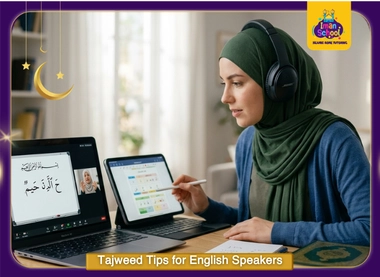
-by Discovering effective Online Tajweed Tips for English Speakers can transform your relationship with the Holy Quran. Applying practical Online Tajweed Tips for English Speakers helps non-native learners overcome pronunciation hurdles and recite with beauty and confidence. At Iman School, our expert tutors guide students through these steps with patient, interactive live instruction.
What Is Tajweed and Why Is It Important?
Tajweed comes from an Arabic root word meaning “betterment” or “beautification.” In the context of Quranic study, Tajweed refers to the precise set of rules governing the correct pronunciation and articulation of every single Arabic letter.
Implementing Online Tajweed Tips for English Speakers ensures that you give every letter its proper rights and qualities (Makharij and Sifat).
The importance of Tajweed goes beyond basic linguistic accuracy. Because the Quran is the direct word of Allah SWT, mispronouncing specific letters can inadvertently alter the true meaning of divine verses.
Following established Online Tajweed Tips for English Speakers preserves the sacred text as it was revealed to Prophet Muhammad ﷺ. When you choose to learn quran with tajweed, you elevate your daily worship and cultivate a deeper, more reverent connection to scripture.
Why Is Tajweed Difficult for English Speakers?
For native English speakers, learning Quranic recitation presents unique phonetic and muscular challenges. English relies on vocal mechanics, tongue movements, and breathing habits that differ greatly from the Arabic language. Many core Arabic sounds originate deep within the throat, pharynx, or specific contact points of the palate that are rarely used in Western speech patterns.
Additionally, English speakers often struggle with vowel length consistency, heavy versus light letters (Tafkheem and Tarqeeq), and rhythmic nasalization (Ghunnah). Standard self-study apps rarely address these physiological nuances.
By applying targeted Online Tajweed Tips for English Speakers, non-native learners can systematically retrain their vocal organs, build muscle memory, and unlock clear, natural recitation habits.

10 Easy Tajweed Tips for English Speakers
Here are 10 practical and actionable Online Tajweed Tips for English Speakers designed to accelerate your learning curve and make recitation effortless.
1- Learn the Arabic Letters First
Before jumping directly into complex verses, focus entirely on mastering the individual Arabic alphabet. Gaining complete familiarity with all 28 letters, their unique shapes, and their short vowel sounds (Harakat) builds a rock-solid foundation. Seeking structured guidance through tajweed for beginners ensures you do not carry early reading mistakes into your long-term study.
2- Practice Makharij
Makharij refers to the specific exit points from which sounds originate, such as the chest, throat, tongue, lips, or nasal cavity. Understanding where each letter produced helps you avoid substituting similar-sounding English consonants. This foundational focus is one of the most transformative Online Tajweed Tips for English Speakers.
3- Focus on Difficult Arabic Sounds
Certain Arabic letters have no equivalent sounds in the English language. Pay special attention to mastering these challenging guttural and emphatic letters:
- Ain (ع) and Ha (ح): Emitted directly from the middle of the throat.
- Kha (خ) and Ghain (غ): Formed in the upper throat near the palate.
- Sad (ص), Dad (ض), Ta (ط), and Za (ظ): Heavy, emphatic letters that require raising the back of the tongue.
- Qaf (ق): Produced from the deepest part of the tongue against the soft palate.
Practicing quran pronunciation for beginners under supervision helps you master these specific sounds accurately.
4- Learn Basic Tajweed Rules
Avoid overwhelming yourself by trying to memorize advanced theoretical books all at once. Start with fundamental rules like Noon Sakinah, Tanween, and Meem Sakinah. Focusing on basic tajweed rules for beginners keeps your momentum high and builds practical confidence step by step.
5- Practice Madd
Madd refers to the elongation of vowel sounds for specific counts (Harakat). Native English speakers often shorten long vowels or unintentionally stretch short ones. Practicing counts of two, four, or six beats ensures your recitation maintains its proper rhythmic flow.
6- Learn Ghunnah
Ghunnah is a pleasant, two-count nasal ring produced primarily through the nose during the recitation of the letters Noon and Meem when stressed (Muschaddad). Mastering this rule is among the essential Online Tajweed Tips for English Speakers that immediately enhances the melody of your recitation.
7- Practice Qalqalah
Qalqalah is the echoing or rebounding sound produced when reciting five specific letters (ق, ط, ب, ج, د) in a state of Sukun (stoppage). Developing proper Qalqalah prevents letters from sounding flat or clipped during pauses.
8- Listen to Qualified Quran Reciters
Immersing your ears in authentic recitation trains your brain to recognize proper cadence, timing, and pitch. Listening regularly to renowned reciters like Sheikh Mahmoud Khalil Al-Husary or Sheikh Ali Al-Hudhaify is one of the most effective Online Tajweed Tips for English Speakers.
9- Record Your Quran Recitation
Use your phone or computer to record yourself reading short passages, then play them back while listening to a master reciter. Comparing the two audio files helps you spot subtle mistakes in vowel lengths or letter emphasis that you might miss while actively reading.
10- Practice with an Online Tajweed Teacher
Self-study can only take you so far because apps cannot listen back to your speech and correct minor mouth placements. Working directly with a qualified teacher ensures immediate feedback, preventing bad habits before they become ingrained. Taking a comprehensive tajweed course online provides the personal accountability required for true fluency.
Common Tajweed Mistakes English Speakers Should Avoid
Non-native learners frequently fall into predictable traps during their initial studies. Recognizing these common errors is key to implementing Online Tajweed Tips for English Speakers effectively:
- Replacing Guttural Letters with English Approximations: Pronouncing Ha (ح) as a soft English H, or Ain (ع) as a simple English vowel A.
- Ignoring Emphatic Tones (Tafkheem): Reading heavy letters like Sin (س) and Sad (ص) identically, which changes the meaning of words.
- Inconsistent Vowel Lengths: Rushing through Madd lengthenings or overly extending standard short vowels (Fatha, Kasra, Damma).
- Neglecting Stoppage Rules (Waqf): Stopping abruptly in the middle of sentences without observing proper pausing signs in the Mus’haf.
Enrolling in online quran classes for english speakers provides targeted drills that eliminate these exact mistakes efficiently.

Can English Speakers Learn Tajweed Without Knowing Arabic?
Yes, absolutely! You do not need to speak fluent conversational Arabic to master Quranic Tajweed. Tajweed focuses on phonetic mechanics, letter articulation, and vocal rules rather than grammar translation or sentence composition.
Thousands of non-Arabic speakers across the globe recite the Holy Quran with exquisite accuracy. Utilizing reliable Online Tajweed Tips for English Speakers allows you to focus on phonetic rules first.
Over time, as your reading becomes smooth, you can pair your recitation practice with vocabulary studies to understand the divine words you recite.
How Long Does It Take to Learn Tajweed?
The timeline for mastering Tajweed varies based on prior reading experience, practice frequency, and the quality of instruction. Here is a general realistic timeline for non-native learners:
- Foundational Stage (1 to 3 Months): Learning Arabic letter shapes, correct Makharij, and short vowels through structured quran recitation for beginners.
- Intermediate Stage (3 to 6 Months): Applying core rules like Ghunnah, Madd, Qalqalah, and basic stopping signs across medium-length Surahs.
- Advanced Fluency (6 to 12 Months): Reciting complex chapters smoothly with complete rule application, steady rhythm, and proper breath management.
Consistency is key. Applying practical Online Tajweed Tips for English Speakers for just 20 to 30 minutes every day yields remarkably fast results.
Why Learn Tajweed with a Qualified Online Teacher?
While video tutorials and audio guides are valuable supplementary resources, they cannot replace interactive human correction. A live teacher hears subtle mispronunciations, identifies tongue positioning issues, and gives you tailored exercises to fix specific challenges.
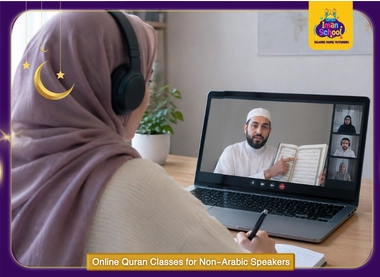
Participating in live online tajweed classes creates a supportive environment where you can ask questions, receive immediate correction, and gain confidence. Whether you are an adult learner or searching for tajweed for english speakers to teach your children, virtual classrooms offer ultimate flexibility around your daily commitments.
Take the first step today to transform your recitation.
Visit our official portal to book your zero-obligation Free Trial Tajweed Class, and experience the warmth and quality of learning with Iman School
FAQ About Tajweed for English Speakers
Can English speakers learn Tajweed online?
Yes, modern virtual classrooms offer interactive live video, digital whiteboards, and real-time audio correction, making virtual Tajweed learning highly effective for non-native speakers.
Can I learn Tajweed without knowing Arabic?
Yes, Tajweed is the study of pronunciation mechanics and recitation rules. You can learn to recite the Quran with complete Tajweed precision even if you do not yet speak or understand conversational Arabic.
Is Tajweed difficult for English speakers?
It presents unique challenges because several Arabic letters do not exist in English. However, with systematic practice and guidance from a qualified tutor, any English speaker can master it.
What is the best way to learn Tajweed online?
The most effective approach is combining independent daily practice with live, one-on-one sessions led by a native, English-fluent teacher who can correct your pronunciation in real time.
How long does it take to learn Tajweed?
With consistent daily practice and weekly lessons, beginners can master fundamental Tajweed rules within 3 to 6 months, achieving fluent reading within a year.
What Arabic letters are difficult for English speakers?
Letters that originate deep in the throat or require tongue elevation are most challenging, including Ain (ع), Ha (ح), Kha (خ), Sad (ص), Dad (ض), Ta (ط), Za (ظ), and Qaf (ق).
Can I learn Quran recitation online?
Yes, interactive digital platforms make it simple for adults and children in Western countries to learn accurate Quranic recitation from certified tutors right from home.
Are online Tajweed classes effective?
Online classes are extremely effective because one-on-one instruction provides focused, undivided attention tailored specifically to your unique vocal strengths and weaknesses.
Why Iman School Is the Best Online Tajweed Academy?
When looking for the ideal partner for your learning journey, Iman School stands out as the Best Online Tajweed Academy for English Speakers. We specialize in providing tailored Quranic education for families living across Western countries, ensuring comfortable, effective, and culturally sensitive learning environments.
At Iman School, our certified scholars are fluent in English and excel at teaching non-native speakers. We offer customized one-on-one sessions, total scheduling flexibility, and comprehensive tracks ranging from introductory reading to advanced recitation.