 -by
-by For any Muslim striving to live an authentic Islamic life, understanding the Quran and Sunnah Relationship is absolutely critical. The Holy Quran serves as the ultimate divine revelation, while the Sunnah provides the living model of how to implement it. At Iman School, we help you navigate the Quran and Sunnah Relationship with structured, comprehensive learning programs tailored to your modern schedule.
What Is the Relationship Between the Quran and the Sunnah?
To truly appreciate how the Islamic faith is practiced, we must examine the primary sources of islamic law that guide every believer’s daily life. When we delve into the Quran and Sunnah Relationship, we must realize that these two foundations are not separate, competing elements; rather, they are divinely integrated.
The Quran represents the literal word of Allah SWT, setting up the overarching theological, moral, and legal parameters of the cosmos. On the other hand, the sunnah in islam represents the divinely inspired path, actions, approvals, and statements of the Prophet Muhammad ﷺ.
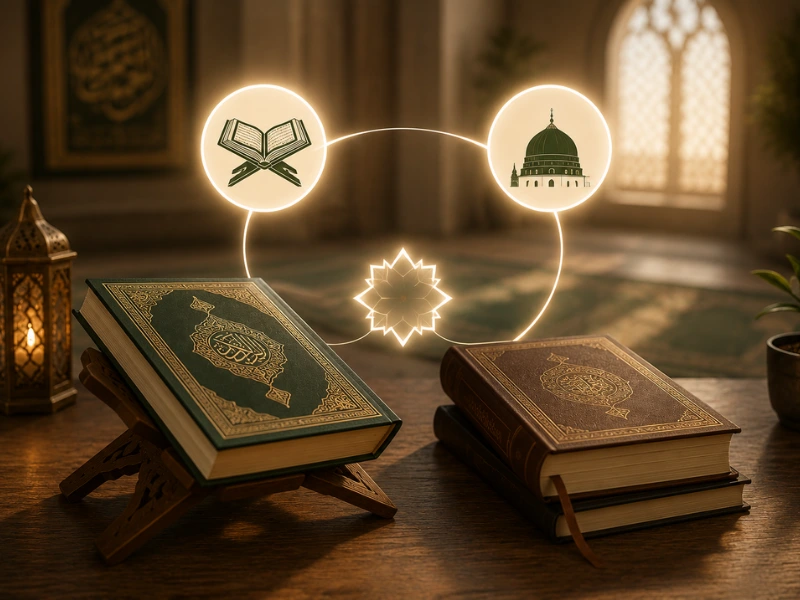
Mathematically and logically, the Quran and Sunnah Relationship functions as a cohesive whole. The Quran provides the grand, divine architectural blueprint, while the Sunnah serves as the practical execution of that very blueprint on earth.
Without the Sunnah, the Quran remains a text of abstract, lofty principles; with the Sunnah, it becomes a breathing, lived reality. This profound relationship between quran and sunnah ensures that the message of Islam remains practical, accessible, and deeply personal for every human being across all generations.
Furthermore, the Quran explicitly mandates this union. Throughout its verses, Allah commands the believers to “Obey Allah and obey the Messenger.” Therefore, studying the quran and sunnah in islam is not an optional academic exercise for scholars. It is an active obligation for any modern Muslim who wishes to establish a deep, meaningful relationship with their Creator.
Why Are Both the Quran and the Sunnah Essential in Islam?
Many modern Muslims living in Western societies struggle to understand why they cannot simply open a translation of the Quran and practice their faith independently. To address this, we must recognize the immense importance of quran and sunnah working in perfect harmony.
This foundational Quran and Sunnah Relationship keeps the entire message of Islam protected from human distortion and subjective misinterpretation.
- Preserving Divine Context: The Quran was revealed progressively over twenty-three years in response to specific real-life events, questions, and historical crises. The Sunnah provides the essential context (Asbab al-Nuzul) that explains exactly why and when certain verses were sent down.
- Preventing Personal Desires from Distorting the Text: Without the historical anchor of the Prophet’s ﷺ practical application, anyone could twist Quranic verses to justify their personal, political, or social whims. The Sunnah sets absolute, objective boundaries for interpreting the divine word.
- Balancing Spiritual Theory and Practical Living: The Quran demands absolute justice, continuous charity, and profound spiritual presence. The Sunnah shows us how to be a parent, a neighbor, a business leader, and a citizen while maintaining those exact high-level spiritual values.
By revealing how the Quran and Sunnah Relationship preserves the spirit of revelation, classical scholars have always maintained that the Quran stands in need of the Sunnah more than the Sunnah stands in need of the Quran. To put it simply: the Book is the law, and the Prophet’s life is the living, breathing commentary of that law.

How Does the Sunnah Explain the Quran?
The primary functional role of prophetic tradition is to explain, clarify, and elaborate on the majestic verses of the Quran. This core dimension of the Quran and Sunnah Relationship can be categorized into three distinct linguistic and legal functions:
Clarifying the General (Tabyeen al-Mujmal)
The Quran frequently issues commands in a brief, general format. For instance, Allah commands the believers to establish prayer (Salah). However, the literal text of the Quran does not detail the specific movements, the number of units (Rak’ahs) for each prayer, or the exact recitations required. The Prophet ﷺ clarified this general command by stating, “Pray as you have seen me praying.”
Restricting the Absolute (Taqyeed al-Mutlaq)
In some instances, Quranic laws are stated in absolute terms. The Sunnah steps in to define the exact boundaries, conditions, and exceptions of these absolute rules. For example, the Quran forbids the consumption of dead animals. The Sunnah restricts this absolute prohibition by explaining that sea creatures and locusts are exempted, making food laws clear and practical for humanity.
Specifying the General (Takhsees al-Aam)
The Quran contains several broad statements that apply universally to all people. The Sunnah refines these statements by identifying specific individuals or situations that are exempted from the general rule. A classic example is the law of inheritance: the Quran lays down general rules for distributing wealth to children, but the Sunnah specifies that prophets do not leave behind material inheritance for their families.
Examples of the Quran and Sunnah Working Together
To fully grasp the Quran and Sunnah Relationship in practice, let us explore some of the most common everyday examples where these two sources interlock perfectly. This beautiful synergy can be seen across various pillars of Islam:
The Practice of Zakat (Obligatory Charity)
The Quran repeatedly commands Muslims to “pay the Zakat.” Yet, you will not find a single verse in the Quran that tells you the exact percentage of your wealth you must give, or what the minimum threshold of savings (Nisab) is before Zakat becomes due. The answers are found exclusively in the quran and hadith dynamic, where the Prophet ﷺ explicitly detailed the 2.5% rate on gold, silver, and business merchandise.
The Rites of Hajj (Pilgrimage)
The Quran establishes Hajj as a duty for those who can afford the journey. But how do we perform the circumambulation (Tawaf) around the Kaaba? How do we run between Safa and Marwa? The Prophet ﷺ clarified these actions during his Farewell Pilgrimage, instructing his companions, “Take your rituals of Hajj directly from me.”
Daily Transaction Ethics
While the Quran establishes the grand moral rule that “Allah has permitted trade and forbidden usury,” the Sunnah details the precise boundaries of ethical business. The Prophet ﷺ prohibited specific deceptive trade practices, monopolization, and hidden interest, translating high-level financial justice into clear, everyday business laws.
These examples prove the Quran and Sunnah Relationship is not just theoretical; it is the very mechanism that makes Islam a highly organized, functional, and uniform global practice.
Whether your immediate goal is to establish a strong spiritual foundation for your young children through our engaging Islamic Creed Course, explore the prophetic biography through our Learn Seerah Online track, or master sacred law by enrolling in a structured Quranic Arabic Course, we cater to every single milestone of your journey.
What Happens If You Follow the Quran Without the Sunnah?
In recent times, some modern movements have attempted to bypass prophetic traditions entirely, claiming that they “only follow the Quran.” Historically and logically, severing the Quran and Sunnah Relationship leads to the immediate collapse of the entire Islamic structure.
When a person rejects the Sunnah, they are left with a text they cannot practically implement. They cannot confidently perform a single daily prayer, they cannot calculate their Zakat, and they cannot complete the Hajj.
By disregarding the Quran and Sunnah Relationship, a believer is left entirely to their own subjective interpretation, which inevitably leads to severe confusion, spiritual isolation, and the eventual disintegration of their faith.
Furthermore, rejecting the Sunnah is a direct contradiction of the Quran itself. The Quran declares that the Prophet ﷺ does not speak from his own desires, and that his character is the ultimate standard of beauty. Therefore, attempting to honor the Quran while rejecting the man who received it is a logical impossibility.
How to Study the Quran and Sunnah Correctly
When you set out to study the Quran and Sunnah Relationship, you must approach the subject with a highly organized, traditional methodology. Because the Arabic language is incredibly deep, relying solely on simple English translations can lead to severe misunderstandings.
- foundational learning roadMAP
- Noorani Qaida (Arabic Letters)
- Tajweed & Fluency (Recitation)
- Tafseer, Hadith, & Fiqh (Understanding)
Structuring your approach to the Quran and Sunnah Relationship avoids the common pitfall of jumping into complex legal debates before mastering the basics of the language.
If you are starting from absolute scratch, it is highly recommended to begin with the Noorani Qaida Course to master pronunciation, followed by structured Quran Recitation Classes to build rhythmic fluency. Once your recitation is solid, you can smoothly transition into systematic studies of exegesis, prophetic narrations, and jurisprudence.
Why Learning with Qualified Islamic Scholars Matters?
Navigating the depth of the Quran and Sunnah Relationship requires guidance from those who have spent decades studying the classical sciences. It is incredibly easy for an untrained reader to open a translation of a Hadith and apply it incorrectly without understanding its grading, context, or legal relationship to other texts.
Working with Certified Islamic Scholars ensures that you learn the material through an authentic, unbroken chain of narration (Isnad). A qualified teacher does not merely read translations to you; they help you understand:
- The historical background behind specific rulings.
- The linguistic nuances of the classical Arabic language.
- How to apply timeless prophetic principles to modern Western dilemmas.
- The difference between universal, unchangeable laws and flexible, culture-specific guidelines.
This academic rigor is precisely what prevents intellectual burnout and helps you build a balanced, confident, and deeply grounded practice of your faith.
We welcome your household to experience our world-class interactive classrooms entirely risk-free. Register on our official website today to secure your zero-obligation Free Trial Islamic Class, and step into a life of confident, authentic, and deeply rewarding sacred learning with Iman School.
Why Iman School Is the Best Online Islamic Studies Academy?
If you are looking for structured, authentic, and highly flexible ways to learn your religion, Iman School provides the ultimate solution. We have built a world-class virtual academy that brings traditional Islamic scholarship directly to your digital screen, accommodating the busy schedules of Muslim families living in the West.
Our premier Online Islamic Studies department features comprehensive courses on the Quran and Sunnah Relationship designed specifically for modern learners. Whether you are seeking an introductory Islamic Studies Course, want to join an intensive Hadith Course Online, or wish to Learn Fiqh Online from home, our platform provides unmatched customization. We pair you with highly qualified, English-fluent mentors who hold traditional authorizations (Ijazahs) to teach sacred knowledge.
Our programs make understanding the Quran and Sunnah Relationship both accessible and highly engaging. Rather than sitting through dry, pre-recorded lectures, you will participate in dynamic, live, one-on-one sessions tailored directly to your personal background, learning speed, and spiritual goals.
We proudly offer specialized tracks including Ten Qira’at Course for advanced learners, as well as our official Quran Ijazah Course for students striving for elite mastery.
FAQ About the Quran and Sunnah Relationship
What Is the Difference Between the Quran and the Sunnah?
The Quran is the literal, uncreated word of Allah SWT revealed directly to the Prophet ﷺ, serving as the miraculous proof of his prophethood. The Sunnah refers to the Prophet’s ﷺ inspired actions, speech, and approvals, which explain and apply the laws of the Quran. This is why studying the Quran and Sunnah Relationship is so crucial for every Muslim.
Why Is the Sunnah Important If We Have the Quran?
The Sunnah is essential to the Quran and Sunnah Relationship because it provides the practical, step-by-step application of the Quran’s commands. Without it, we would not know how to pray, fast, pay charity, or conduct ethical business transactions.
Can Muslims Follow the Quran Without the Sunnah?
No. By attempting to ignore the Quran and Sunnah Relationship, one cannot fulfill the most basic commands of the Quran, such as establishing prayer or paying Zakat, as these require prophetic clarification to be practiced.
How Does the Sunnah Explain the Quran?
The Sunnah explains the Quran by clarifying general concepts, defining the exact boundaries of absolute rules, and specifying exceptions to broad, universal guidelines. This dynamic remains a cornerstone of the Quran and Sunnah Relationship.
Where Should Beginners Start Learning the Quran and Sunnah?
To build an understanding of the Quran and Sunnah Relationship, beginners should start by learning basic Arabic pronunciation, mastering foundational creed, and taking a structured Islamic studies for beginners course that covers the core lessons of prophetic biography and basic jurisprudence.
Best Online Islamic Studies School
Deciding to master your religion and comprehend the Quran and Sunnah Relationship is one of the most significant steps you can take for your personal and spiritual growth. While self-study books are wonderful, having direct access to a structured, live curriculum is what ensures accurate, lifelong retention. At Iman School, we stand out globally as the premier virtual space custom-tailored to help Western Muslims learn islam online.
Our elite digital platform provides highly engaging Online Quran Classes and structured modules to help you Learn Hadith Online from the comfort of home. We selectively recruit our instructors for their academic excellence, pedagogical warmth, and flawless English communication. Through our flexible portals, we make it simple to Learn Quran Online and master Fiqh for Beginners without compromising your academic or professional career.